Understanding Kotlin Coroutines Flow Internals: The Cancellation Mechanism
Japanese version: This article is also available in Japanese on Zenn.
I have been decoding the internal implementation of Kotlin Coroutines Flow from its source code, aiming to demystify Flow for developers who use it as a black box.
In previous articles, I covered Flow Builders like flow, Terminal Operators like collect, and Intermediate Operators like map, filter, flowOn, and buffer — all from their internal implementations.
- Part 1. Understanding Kotlin Coroutines Flow Internals: Flow Builder, emit, and collect
- Part 2. Understanding Kotlin Coroutines Flow Internals: How map and filter Work
- Part 3. Understanding Kotlin Coroutines Flow Internals: How flowOn Switches Execution Contexts
- Part 4. Understanding Kotlin Coroutines Flow Internals: Buffering and Conflation
So far, we have only looked at cases where processing completes normally. From here, we look at how Flow handles abnormal cases — specifically, “cancellation” and “exceptions.” These are important topics in production code, yet the behavior can be difficult to predict. By understanding the internal implementation, we aim to be able to accurately picture what actually happens at runtime.
This article focuses on the former: cancellation. The next article will cover the latter: exception handling.
Note: The version of
kotlinx.coroutines1 used in this article is v1.10.2, the latest version at the time of writing.
Basic Specs of Flow’s Cancellation Mechanism
Let’s review the basic specs of Flow’s cancellation mechanism from the official documentation2.
The following code cancels a simple Flow that emits values every 1000ms using withTimeoutOrNull3 at the 2500ms mark.
fun simple(): Flow<Int> = flow {
    for (i in 1..3) {
        delay(1000)
        println("Emitting $i")
        emit(i)
    }
}

fun main() = runBlocking<Unit> {
    val time = measureTimeMillis {
        withTimeoutOrNull(2500) { // Timeout after 2500ms
            simple().collect { value -> println(value) }
        }
    }
    println("Cancelled in $time ms")
}Looking at the output, we can see that after the second value is emitted, the Flow is cancelled during the delay before the third value is emitted.
Output:
Emitting 1
1
Emitting 2
2
Cancelled in 2565 ms
This is a very basic example, but let’s look at how this cancellation behavior is achieved from the internal implementation.
Internal Implementation of the Cancellation Mechanism
Let’s look at what’s happening under the hood in the sample code above.
How withTimeoutOrNull Works
Although not part of Flow’s implementation itself, let’s first examine how withTimeoutOrNull works.
The implementation of withTimeoutOrNull is shown below.
public suspend fun <T> withTimeoutOrNull(timeMillis: Long, block: suspend CoroutineScope.() -> T): T? {
    if (timeMillis <= 0L) return null

    var coroutine: TimeoutCoroutine<T?, T?>? = null
    try {
        return suspendCoroutineUninterceptedOrReturn { uCont ->
            val timeoutCoroutine = TimeoutCoroutine(timeMillis, uCont)
            coroutine = timeoutCoroutine
            setupTimeout<T?, T?>(timeoutCoroutine, block)
        }
    } catch (e: TimeoutCancellationException) {
        // Return null if it's our exception, otherwise propagate it upstream (e.g. in case of nested withTimeouts)
        if (e.coroutine === coroutine) {
            return null
        }
        throw e
    }
}A TimeoutCoroutine is created, and then setupTimeout is called with that TimeoutCoroutine and the lambda (block) passed to withTimeoutOrNull.
Looking at the implementation of TimeoutCoroutine, when its run method (a method of the Runnable interface) is called, the coroutine itself is cancelled.
private class TimeoutCoroutine<U, in T : U>(
    @JvmField val time: Long,
    uCont: Continuation<U> // unintercepted continuation
) : ScopeCoroutine<T>(uCont.context, uCont), Runnable {
    override fun run() {
        cancelCoroutine(TimeoutCancellationException(time, context.delay, this))
    }
}The implementation of setupTimeout is shown below.
private fun <U, T : U> setupTimeout(
    coroutine: TimeoutCoroutine<U, T>,
    block: suspend CoroutineScope.() -> T
): Any? {
    // schedule cancellation of this coroutine on time
    val cont = coroutine.uCont
    val context = cont.context
    coroutine.disposeOnCompletion(context.delay.invokeOnTimeout(coroutine.time, coroutine, coroutine.context))
    // restart the block using a new coroutine with a new job,
    // however, start it undispatched, because we already are in the proper context
    return coroutine.startUndispatchedOrReturnIgnoreTimeout(coroutine, block)
}setupTimeout does three main things:
- First, it registers the cancellation logic to be executed on timeout with the scheduler. This is handled by
context.delay.invokeOnTimeout(coroutine.time, coroutine, coroutine.context). On timeout, therunmethod ofTimeoutCoroutinedescribed above will be called. - Second, it ensures that the scheduled cancellation is disposed when the coroutine completes normally. This is handled by
coroutine.disposeOnCompletion. - Third, it launches the coroutine and executes the lambda (
block) passed towithTimeoutOrNull. This is handled bycoroutine.startUndispatchedOrReturnIgnoreTimeout.
In summary, withTimeoutOrNull launches a coroutine (TimeoutCoroutine), executes the passed lambda, and schedules the TimeoutCoroutine to be cancelled after the specified duration. Next, let’s see how this TimeoutCoroutine cancellation propagates to Flow cancellation.
How Flow Gets Cancelled
First, let’s review the Flow execution flow uncovered in Part 1.
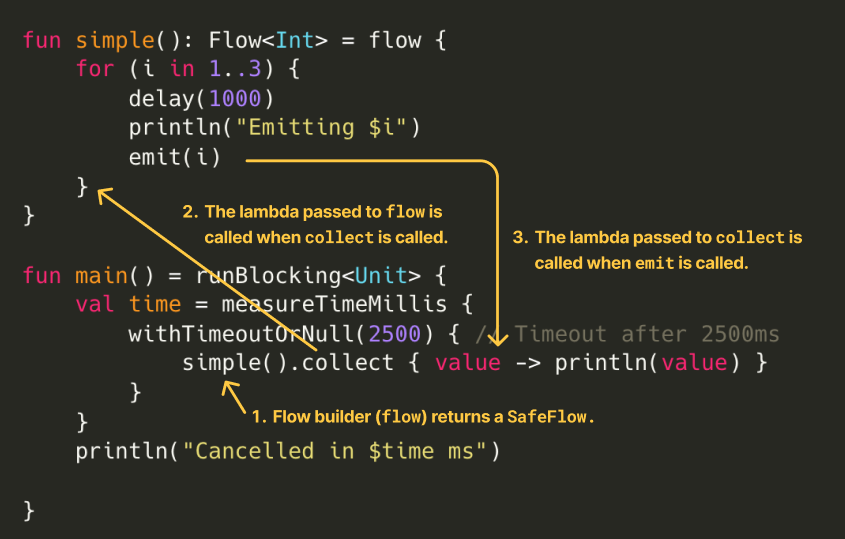 Flow execution flow
Flow executes in the following steps:
- The Flow Builder (
flowfunction) returns an instance ofSafeFlow. - When
collectis called onSafeFlow, the lambda passed toflowis invoked. - When
emitis called inside the lambda passed toflow, the lambda passed tocollectis called.
In the sample code above, let’s verify which coroutines execute the flow lambda and collect lambda with the following code.
fun simple(): Flow<Int> = flow {
    val job = currentCoroutineContext()[Job]!!
    println("[flow lambda]    Job@${"%x".format(System.identityHashCode(job))} (${job::class.simpleName})")
    for (i in 1..3) {
        delay(1000)
        emit(i)
    }
}

fun main() = runBlocking<Unit> {
    val runBlockingJob = coroutineContext[Job]!!
    println("[runBlocking]    Job@${"%x".format(System.identityHashCode(runBlockingJob))} (${runBlockingJob::class.simpleName})")

    val time = measureTimeMillis {
        withTimeoutOrNull(2500) {
            val timeoutJob = coroutineContext[Job]!!
            println("[withTimeout]    Job@${"%x".format(System.identityHashCode(timeoutJob))} (${timeoutJob::class.simpleName})")
            println("[withTimeout]    child of runBlocking? ${runBlockingJob.children.contains(timeoutJob)}")

            simple().collect { value ->
                val collectJob = currentCoroutineContext()[Job]!!
                println("[collect lambda] Job@${"%x".format(System.identityHashCode(collectJob))}")
                println("[collect lambda] === timeoutJob? ${collectJob === timeoutJob}")
                println(value)
            }
        }
    }
    println("Cancelled in $time ms")
}Looking at the output, we can see that both the flow lambda and the collect lambda run on the TimeoutCoroutine that withTimeoutOrNull creates. This means that when TimeoutCoroutine is cancelled, those lambdas are naturally cancelled as well.
Output:
[runBlocking]    Job@6aceb1a5 (BlockingCoroutine)
[withTimeout]    Job@1936f0f5 (TimeoutCoroutine)
[withTimeout]    child of runBlocking? true
[flow lambda]    Job@1936f0f5 (TimeoutCoroutine)
[collect lambda] Job@1936f0f5
[collect lambda] === timeoutJob? true
1
[collect lambda] Job@1936f0f5
[collect lambda] === timeoutJob? true
2
Cancelled in 2532 ms
However, cancellation of suspend functions is a cooperative mechanism — it is never forced like an interrupt. Even if a coroutine is already cancelled, the running code will not be suspended unless it calls ensureActive to throw a CancellationException or calls yield to yield the thread.
In this case, delay4 is a cancellable suspend function that is immediately interrupted on cancellation, which is why the Flow can be cancelled even mid-delay.
Note: For more details on cancellation behavior in Kotlin Coroutines, see the official documentation5.
Cancellation When There Is No delay
In the previous example, the Flow could be cancelled mid-execution because delay is a cancellable suspend function. What happens when there is no delay?
Let’s run the following sample code to find out. The key difference from the earlier code is that the delay before emit has been removed, and the timeout has been shortened to 10ms.
fun simple(): Flow<Int> = flow {
    for (i in 1..100) {
        println("Emitting $i")
        emit(i)
    }
}

fun main() = runBlocking<Unit> {
    withTimeoutOrNull(10) { // Timeout after 10ms
        simple().collect { value -> println(value) }
    }
    println("Done")
}Looking at the output, we can see that even without delay, the flow lambda is cancelled mid-execution (the exact number of values emitted before cancellation varies per run).
Output:
Emitting 1
1
Emitting 2
2
...
Emitting 59
59
Emitting 60
Done
The reason the flow can still be cancelled mid-execution is that ensureActive is called inside emit.
When emit is called inside flow, SafeCollector’s emit is executed. Looking at the source code of SafeCollector’s emit (the JVM implementation below), we can confirm that currentContext.ensureActive() is indeed called.
private fun emit(uCont: Continuation<Unit>, value: T): Any? {
    val currentContext = uCont.context
    currentContext.ensureActive() // 👈 HERE
    // This check is triggered once per flow on a happy path.
    val previousContext = lastEmissionContext
    if (previousContext !== currentContext) {
        checkContext(currentContext, previousContext, value)
        lastEmissionContext = currentContext
    }
    completion_ = uCont
    val result = emitFun(collector as FlowCollector<Any?>, value, this as Continuation<Unit>)
    /*
     * If the callee hasn't suspended, that means that it won't (it's forbidden) call 'resumeWith` (-> `invokeSuspend`)
     * and we don't have to retain a strong reference to it to avoid memory leaks.
     */
    if (result != COROUTINE_SUSPENDED) {
        completion_ = null
    }
    return result
}Cancellation When the Execution Context Is Switched
In the examples so far, Flow has run in a single execution context (coroutine). But what happens when the execution context is switched via flowOn? How does cancellation propagate in that case?
By running the following code, we can reveal the coroutine structure that executes the flow lambda and collect lambda. printJobTree is a helper function that prints the descendant structure of a given Job as a tree.
fun printJobTree(job: Job, indent: String = "", connector: String = "") {
    println("$connector@${"%x".format(System.identityHashCode(job))}[${job::class.simpleName}]")
    val children = job.children.toList()
    children.forEachIndexed { i, child ->
        val isLast = i == children.lastIndex
        printJobTree(
            child,
            indent = indent + if (isLast) "    " else "│   ",
            connector = indent + if (isLast) "└── " else "├── "
        )
    }
}

fun simple(): Flow<Int> = flow {
    val job = currentCoroutineContext()[Job]!!
    println("[flow lambda]    Job@${"%x".format(System.identityHashCode(job))} (${job::class.simpleName}) thread: ${Thread.currentThread().name}")
    for (i in 1..3) {
        delay(1000)
        emit(i)
    }
}

fun main() = runBlocking<Unit> {
    val runBlockingJob = coroutineContext[Job]!!
    println("[runBlocking]    Job@${"%x".format(System.identityHashCode(runBlockingJob))} (${runBlockingJob::class.simpleName}) thread: ${Thread.currentThread().name}")

    val time = measureTimeMillis {
        withTimeoutOrNull(2500) {
            val timeoutJob = coroutineContext[Job]!!
            println("[withTimeout]    Job@${"%x".format(System.identityHashCode(timeoutJob))} (${timeoutJob::class.simpleName}) thread: ${Thread.currentThread().name}")

            simple().flowOn(Dispatchers.IO).collect { value ->
                val collectJob = currentCoroutineContext()[Job]!!
                println("[collect lambda] Job@${"%x".format(System.identityHashCode(collectJob))} (${collectJob::class.simpleName}) thread: ${Thread.currentThread().name}")
                printJobTree(timeoutJob)
                println(value)
            }
        }
    }
    println("Cancelled in $time ms")
}This produces the following output.
Output:
[runBlocking]    Job@6aceb1a5 (BlockingCoroutine) thread: main @coroutine#1
[withTimeout]    Job@1936f0f5 (TimeoutCoroutine) thread: main @coroutine#1
[flow lambda]    Job@1ca9258a (ProducerCoroutine) thread: DefaultDispatcher-worker-1 @coroutine#2
[collect lambda] Job@73ad2d6 (ScopeCoroutine) thread: main @coroutine#1
@1936f0f5[TimeoutCoroutine]
└── @73ad2d6[ScopeCoroutine]
    └── @1ca9258a[ProducerCoroutine]
1
[collect lambda] Job@73ad2d6 (ScopeCoroutine) thread: main @coroutine#1
@1936f0f5[TimeoutCoroutine]
└── @73ad2d6[ScopeCoroutine]
    └── @1ca9258a[ProducerCoroutine]
2
Cancelled in 2538 ms
The three key points are:
- A parent-child hierarchy of
TimeoutCoroutine→ScopeCoroutine→ProducerCoroutineis formed. - The
flowlambda runs onProducerCoroutine(Dispatchers.IO). - The
collectlambda runs onScopeCoroutine(main thread).
These three points can be explained by what we learned in Part 3.
First, flowOn creates a ChannelFlow. Inside ChannelFlow’s collect, child coroutines are created.
public abstract class ChannelFlow<T>(/** omitted */) : FusibleFlow<T> {
    public open fun produceImpl(scope: CoroutineScope): ReceiveChannel<T> =
        // 👇 Creates `ProducerCoroutine` from `ScopeCoroutine`.
        scope.produce(context, produceCapacity, onBufferOverflow, start = CoroutineStart.ATOMIC, block = collectToFun)

    override suspend fun collect(collector: FlowCollector<T>): Unit =
        // 👇 Creates `ScopeCoroutine` from `TimeoutCoroutine`.
        coroutineScope {
            collector.emitAll(produceImpl(this))
        }
}First, coroutineScope creates a ScopeCoroutine from the TimeoutCoroutine. Then, inside produceImpl, a ProducerCoroutine is created from the ScopeCoroutine, and the flow lambda runs on this ProducerCoroutine (Dispatchers.IO). Values emitted upstream inside flow are received via a Channel by the downstream ScopeCoroutine (main thread), where the collect lambda is executed (this is what happens inside emitAll).
The key takeaway for understanding the cancellation mechanism is: although the execution contexts differ across phases, these coroutines form a parent-child hierarchy, so cancellation propagates to all of them.
Cases Where Flow Is Not Cancelled
So far, we have seen cases where Flow is cancelled due to cancellable functions like delay and emit. However, there are also cases where Flow is not cancelled. One example is when creating a Flow with IntRange.asFlow.
Running the following code shows that even when cancel is explicitly called, the Flow runs to completion without being cancelled.
fun main() = runBlocking<Unit> {
    (1..5).asFlow().collect { value ->
        if (value == 3) cancel()
        println(value)
    }
}Output:
1
2
3
4
5
Exception in thread "main" kotlinx.coroutines.JobCancellationException: BlockingCoroutine was cancelled
 at kotlinx.coroutines.JobSupport.cancel (JobSupport.kt:1558)
 at kotlinx.coroutines.CoroutineScopeKt.cancel (CoroutineScope.kt:287)
 at kotlinx.coroutines.CoroutineScopeKt.cancel$default (CoroutineScope.kt:285)
The reason can also be confirmed from the internal implementation. Here is the source code of Iterable<T>.asFlow().
public fun <T> Iterable<T>.asFlow(): Flow<T> = flow {
    forEach { value ->
        emit(value)
    }
}Confusingly, the flow function called inside asFlow is not the public flow function but rather an internal unsafeFlow function.
internal inline fun <T> unsafeFlow(@BuilderInference crossinline block: suspend FlowCollector<T>.() -> Unit): Flow<T> {
    return object : Flow<T> {
        override suspend fun collect(collector: FlowCollector<T>) {
            collector.block()
        }
    }
}Unlike the public flow function, unsafeFlow does not create a SafeFlow. Therefore, when emit is called inside unsafeFlow, it does not go through SafeCollector’s emit (where ensureActive is called, as explained earlier), and instead calls the collect lambda directly. This is why the Flow keeps running even after the coroutine is already cancelled.
On the other hand, using asFlow().cancellable() makes the Flow cancellable mid-execution.
fun main() = runBlocking<Unit> {
    (1..5).asFlow().cancellable().collect { value ->
        if (value == 3) cancel()
        println(value)
    }
}Output:
1
2
3
Exception in thread "main" kotlinx.coroutines.JobCancellationException: BlockingCoroutine was cancelled
 at kotlinx.coroutines.JobSupport.cancel (JobSupport.kt:1558)
 at kotlinx.coroutines.CoroutineScopeKt.cancel (CoroutineScope.kt:287)
 at kotlinx.coroutines.CoroutineScopeKt.cancel$default (CoroutineScope.kt:285)
The implementation of cancellable() is straightforward.
public fun <T> Flow<T>.cancellable(): Flow<T> =
    when (this) {
        is CancellableFlow<*> -> this // Fast-path, already cancellable
        else -> CancellableFlowImpl(this)
    }

internal interface CancellableFlow<out T> : Flow<T>

private class CancellableFlowImpl<T>(private val flow: Flow<T>) : CancellableFlow<T> {
    override suspend fun collect(collector: FlowCollector<T>) {
        flow.collect {
            currentCoroutineContext().ensureActive()
            collector.emit(it)
        }
    }
}cancellable() wraps the original Flow in CancellableFlowImpl, a type of Flow. This acts as an intermediary during emit calls — when emit is called inside unsafeFlow, currentCoroutineContext().ensureActive() is called first, and only then is the downstream collect lambda invoked.
Summary
In this article, we have revealed the cancellation mechanism of Flow from its internal implementation.
To summarize: by understanding the collect and emit call flow learned in Part 1, knowing at which points a suspend function becomes cancellable (i.e., where ensureActive or equivalent is called), and examining the parent-child coroutine structure when execution contexts are switched, we can naturally derive the cancellation behavior of Flow.
Footnotes
-
Kotlin/kotlinx.coroutines: https://github.com/Kotlin/kotlinx.coroutines ↩ -
Flow cancellation basics: https://kotlinlang.org/docs/flow.html#flow-cancellation-basics ↩
-
withTimeoutOrNull: https://kotlinlang.org/api/kotlinx.coroutines/kotlinx-coroutines-core/kotlinx.coroutines/with-timeout-or-null.html ↩ -
delay: https://kotlinlang.org/api/kotlinx.coroutines/kotlinx-coroutines-core/kotlinx.coroutines/delay.html ↩ -
Cancellation: https://kotlinlang.org/docs/cancellation-and-timeouts.html ↩